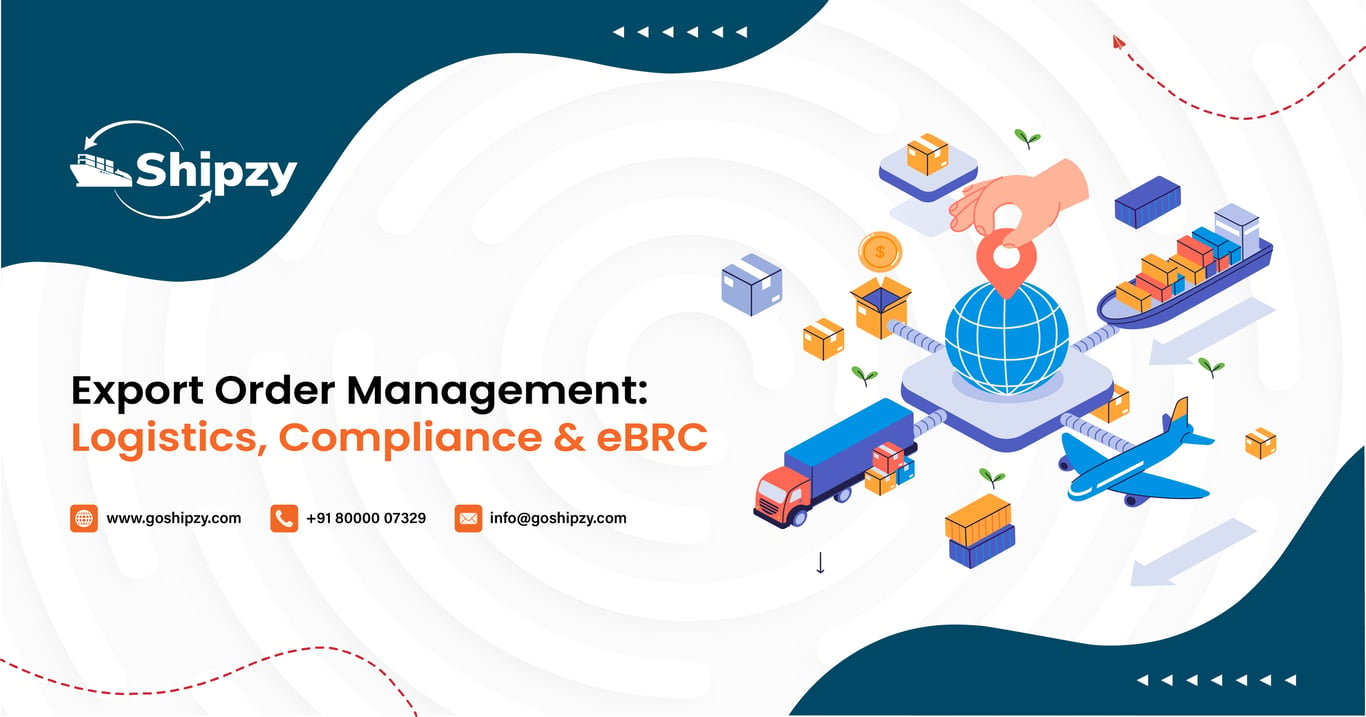
An export procedure flow chart maps the journey from buyer enquiry and order confirmation to procurement, production, documentation, customs clearance, shipment, payment reconciliation, EDPMS, eBRC and closure. For Indian exporters, it should show who owns each step like to do list, what information is required and what must be approved before work moves forward.
To improve the process, connect every shipment to its buyer order, reuse approved data across documents and track exceptions before deadlines are missed. Keep dispatch, delivery, payment receipt, eBRC generation and EDPMS closure as separate milestones.
This guide explains a practical workflow for manufacturers and merchant exporters, including a three-product example and controls that help teams prevent document mismatches and protect order margins.
What are the typical steps in an export procedure flow chart?
The following sequence is an operational template for goods exports. Freight planning, documentation and production often overlap; payment timing depends on the contract.
|
Stage |
Main activity |
Suggested owner |
|---|---|---|
|
1. Enquiry and quotation |
Confirm specifications, price and delivery terms |
Sales |
|
2. Order confirmation |
Approve buyer PO, contract and payment terms |
Sales and finance |
|
3. Compliance review |
Check product, destination and document requirements |
Compliance |
|
4. Procurement or production |
Secure goods and record quantities and batches |
Purchase and production |
|
5. Quality and packing |
Release goods and confirm final packing data |
Quality and warehouse |
|
6. Freight and documents |
Book transport and approve shipment documents |
Logistics and documentation |
|
7. Customs clearance |
File declarations and obtain export clearance |
Exporter and customs broker |
|
8. Shipment and delivery |
Track departure, transport documents and delivery |
Logistics |
|
9. Payment and closure |
Reconcile proceeds, bank records and final costs |
Finance |
Give each stage a completion rule. “Documents prepared” is different from “documents checked and approved by customer”
How does the export process work in practice?
1. Confirm the buyer order and commercial terms
Record product specifications, quantities, packing, currency, payment terms, delivery dates and the agreed Incoterms® rule with its named place or port.
Check differences between the quotation, buyer purchase order and sales contract before approval. If the buyer changes packaging later, assess the effect on production, freight and price.
Practical control: Keep an approved order version. Record subsequent changes with their approver and date.
2. Check compliance before committing to shipment
Build a checklist for the product, destination and transaction. Review the applicable HS classification, export policy, IEC and registration requirements, authorisations and destination-specific documentation.
Avoid one universal checklist for every industry. A spice shipment, pharmaceutical consignment and dangerous-goods chemical shipment can need very different evidence.
Assign responsibility for confirming each requirement and record its source and review date. Repeat the check when the product, destination or relevant rules change.
3. Connect procurement and production to the order
Manufacturers should link purchase orders, material receipts, quality checks, work orders and finished-goods batches to the export requirement.
Merchant exporters can follow a shorter route: supplier purchase, inspection, packing and dispatch. Retain supplier and lot references for traceability.
Export order management software for manufacturers should distinguish ordered, produced, quality-approved, allocated and dispatched quantities. Treating all available stock as shipment-ready can hide shortages.
4. Finalise quality, packing and shipment quantities
Use actual packing data to confirm package count, net weight, gross weight, marks and batch details.
Illustrative example: A spice exporter receives this order:
|
Product |
Ordered quantity |
Net weight per bag |
Expected bags |
|---|---|---|---|
|
Cumin |
10,000 kg |
25 kg |
400 |
|
Coriander |
5,000 kg |
20 kg |
250 |
|
Turmeric |
3,000 kg |
25 kg |
120 |
|
Total |
18,000 kg |
- |
770 |
If coriander packing changes to 25 kg per bag, its bag count becomes 200. Total packages become 720 while net weight remains 18,000 kg.
The packing list and affected shipping instructions must reflect the approved change. Gross weight must come from actual packing records, including packaging weight.
5. Book freight and prepare consistent documents
Compare freight offers on the same basis: route, equipment, transit time, local charges, THC, free time, validity and exclusions. Allocate each charge according to the agreed commercial terms.
DGFT identifies the core export documents as the relevant transport document, commercial invoice cum packing list, and shipping bill or applicable export declaration. Separate invoices and packing lists are also accepted; additional documents depend on the goods and transaction. [1]
Prepare documents at their appropriate stage. The final carrier-issued transport document may follow shipment; a draft bill of lading is not the final issued document.
6. Complete customs clearance and confirm departure
Coordinate shipping bill filing, supporting documents, goods registration and any required assessment or examination with the customs broker.
Let Export Order (LEO) is a customs clearance milestone. It should not be treated as proof that the vessel or aircraft has departed. ICEGATE documentation distinguishes shipping bills, LEO and export manifest messages. [2]
Track clearance, loading, actual departure and relevant manifest status separately. Assign an owner to resolve mismatches or missing records.
7. Reconcile payment and close the export records
Match receipts against invoices and shipments, explaining partial payments, deductions and outstanding balances.
DGFT's revamped eBRC process allows exporters to generate certificates through self-certification using bank-uploaded Inward Remittance Messages (IRMs) and relevant export details. [3]
EDPMS is a separate RBI monitoring system. Under the regulations effective from 1 October 2026, Authorised Dealers handle the relevant updates and closure of export entries. An eBRC should not be treated as evidence that an EDPMS entry has automatically closed. [4]
Track payment reconciliation, eBRC status and bank-confirmed EDPMS status separately.
How can you optimise your export workflow?
Use one approved set of order and shipment data
Generate documents from shared, approved records instead of repeatedly typing buyer names, quantities and values.
Separate planned values from final shipment values. When packing changes, identify affected documents and approvals before issuing revised copies.
Combine AI checks with clear validation rules
An AI tool for export documentation errors can assist with extracting and comparing information from purchase orders, invoices, packing lists and shipping instructions.
Use fixed rules for arithmetic, currency, quantities and package totals. AI can help flag wording differences, but an authorised person should resolve exceptions and approve final documents.
Test the tool with real mismatches. Ask whether it shows the conflicting fields and source documents, rather than merely declaring a file “correct.”
Make the dashboard show blockers and ownership
An end-to-end export shipment status dashboard should answer:
-
What is the next action?
-
Who owns it?
-
When is it due?
-
What is blocking completion?
“Packing list awaiting approval; documentation manager; due today” gives the team something actionable. “Shipment in progress” does not.
Track expected and actual order contribution
Maintain a consistent calculation:
Order contribution = net sales revenue − product cost − attributable shipment costs
Include applicable processing, packing, freight, insurance, handling, inspection, banking and commission costs without double-counting amounts already included in product cost.
Compare the quotation estimate with actual costs after shipment. Keep unreceived supplier bills visible as accruals or estimates; otherwise, an unfinished cost sheet can overstate the margin.
Common export process mistakes to avoid
|
Mistake |
Better control |
|---|---|
|
Closing the order when goods leave the factory |
Track shipment, payment and compliance closure separately |
|
Reusing documents from a previous shipment |
Generate from current approved records |
|
Updating bag count in only one document |
Review all documents affected by packing changes |
|
Choosing freight on the headline rate alone |
Compare total applicable charges and service terms |
|
Showing overdue work without an owner |
Assign responsibility and escalation dates |
Build a process your team can run consistently
Start with one live export order. Map its handovers, assign owners and define what “complete” means at each stage. Then standardise the records and automate repetitive work.
When evaluating Shipzy, bring that order to the demonstration. Ask the team to walk through production or procurement, document revisions, partial shipments, shipment costs and payment reconciliation. Confirm the scope of each integration and who remains responsible for external filings.
The goal is a process where your team can see what needs attention before it becomes a shipment delay.
Frequently asked questions
What is an export procedure flow chart?
It is a visual or structured map of the steps required to fulfil an export order, from enquiry and order approval through goods preparation, documentation, customs clearance, shipment and financial closure.
What documents are normally required for goods exports from India?
Core documents include a commercial invoice and packing list, a shipping bill or applicable export declaration, and the transport document appropriate to the shipment mode. Product, destination, buyer and payment requirements can add further documents. [1]
How does the process differ for merchant exporters?
Merchant exporters generally replace in-house production with supplier procurement and inspection. They still need controls for product specifications, traceability, packing, documents, shipment execution and payment reconciliation.
Can AI prevent all export documentation errors?
No. AI can help identify inconsistencies, but it can miss errors or interpret information incorrectly. Combine it with validation rules, approved master data and human review before issuing documents.
Does generating an eBRC close EDPMS?
No automatic closure should be assumed. eBRC generation follows DGFT's process, while the Authorised Dealer handles EDPMS updates and closure. Verify each status independently. [3][4]
Key Takeaways
-
Map the export process through financial closure, not just dispatch.
-
Reuse approved data and control changes across related documents.
-
Track planned quantities separately from actual packing and shipment data.
-
Use AI-assisted checks alongside fixed rules and human approval.
-
Keep eBRC, EDPMS and order-cost closure independently visible.
Authoritative Sources
-
DGFT: Customs Import Export Procedures — core documents; additional requirements vary.
-
ICEGATE: e-Filing Messages and Customs Circular 29/2018 — customs workflow and distinct electronic messages.
-
RBI: Foreign Exchange Management (Export and Import of Goods and Services) Regulations, 2026, amended through 22 September 2026.